Revelation of Olympia as an automaton
The revelation of Olympia as an automaton is the catastrophic climax of E. T. A. Hoffmann's 'The Sandman', the moment when Nathaniel's deluded passion shatters against the brutal fact that the beloved he worshipped was never alive. The scene collapses the story's central oppositions—love and mechanism, sight and blindness, the poetic and the prosaic—into a single, violent tableau: a dismembered doll, a pair of bloody eyes flung across a room, and a young man's mind breaking under the weight of what he has seen.
The Fight Over Olympia
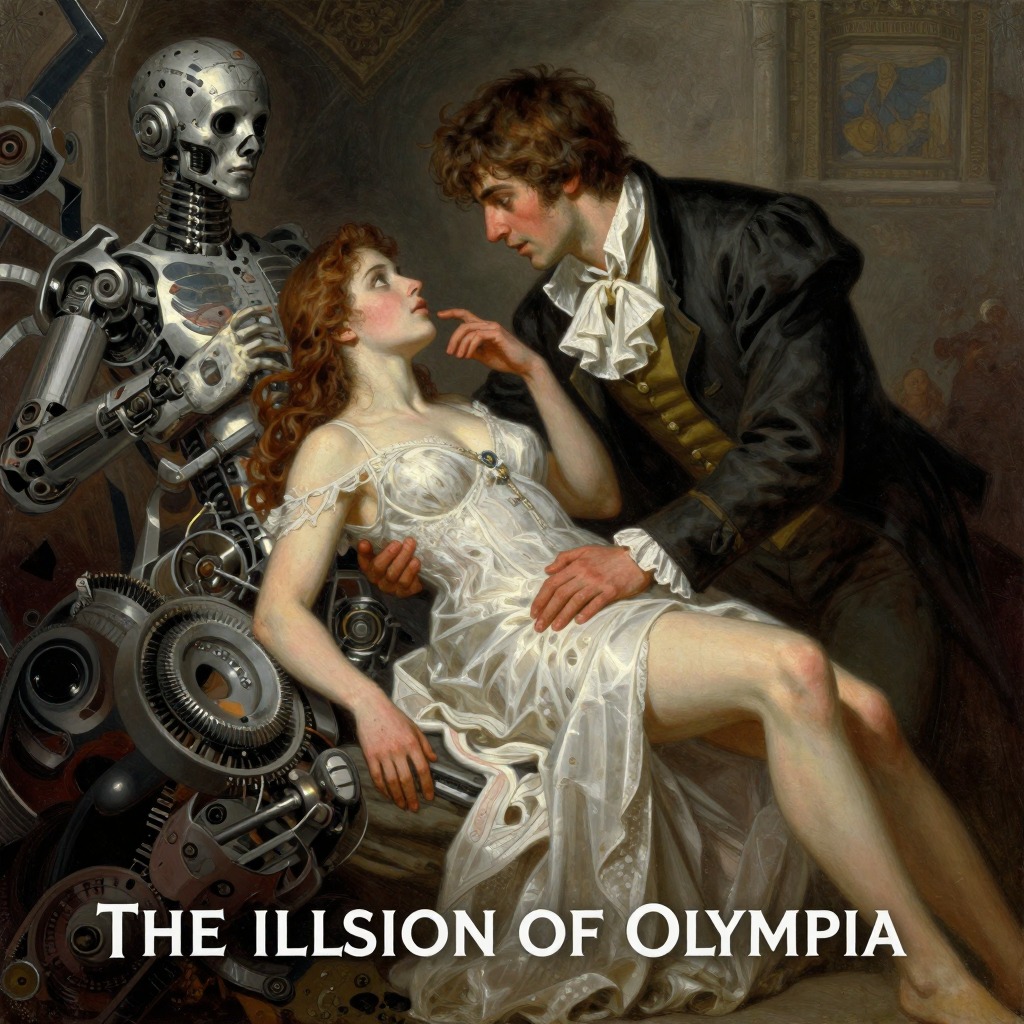
Nathaniel arrives at Spalanzani's house intending to propose marriage to Olympia, carrying the ring his mother gave him when he left home. But from the doorstep he hears a strange din—stamping, clattering, shoving, pounding on doors, interspersed with coarse words and hurled imprecations. The voices of Spalanzani and Coppelius screech and rage at each other. Nathaniel bursts in and finds the Professor gripping a female figure by the shoulders while the Italian Coppola holds her by the feet; they tug and tear her back and forth, furiously fighting for possession. The figure is Olympia. With a mighty burst of strength, Coppola yanks her free from Spalanzani's hands, swings her around, and deals Nathaniel a stunning blow that sends him tumbling backwards over a work table, toppling phials, retorts, bottles, and measuring glasses that smash into a thousand pieces on the floor. Coppola then flings the figure over his shoulder and races down the steps with a repulsive, shrill laugh, the ugly dangling feet of the figure banging with a wooden thud and thump on every step.
The Doll's True Nature
Nathaniel, stunned, sees what he had refused to see: Olympia's deathly pallid wax face has no eyes—only black hollows in their stead. She is a lifeless doll. Spalanzani, thrashing on the floor with glass shards cutting his head, chest, and arms, blood spurting like a fountain, pulls himself together and shouts for Nathaniel to pursue Coppola, who has robbed him of his finest automaton—twenty years' work, life and limb invested, the clockwork, speech, and step all his. The eyes, he cries, were stolen from Nathaniel. Then Nathaniel spots a pair of bloody eyes peering at him from the floor. Spalanzani grasps them with his uninjured hand and flings them at Nathaniel, striking him on the breast. At that moment madness seizes Nathaniel, tearing his thinking and feeling to shreds. He begins to scream about a ring of fire and a wooden doll, flings himself at Spalanzani, and presses his fingers to the Professor's throat. He would have strangled him, but people storm in, tear the raging Nathaniel away, and save the old man's life. Siegmund cannot restrain the madman, who keeps screaming in a terrifying voice, lashing about with balled fists. It takes the combined strength of many men to overpower him, fling him to the floor, and tie him up. His words dissolve into a terrible beastly bellowing, and he is taken to the madhouse.
Consequences and Aftermath
Spalanzani recovers from his wounds but is forced to leave the university, as Nathaniel's story stirs up a public uproar. It is commonly held to be an altogether fraudulent swindle to pass off a wooden doll for a living person in proper society. Jurists call it a refined and therefore all the harder to punish swindle. A dreadful distrust of human figures seeps into the souls of the townspeople; many lovers demand that their beloveds sing off-key, dance out of step, embroider and knit while being read to, and above all speak in a way that demonstrates their words derive from actual thought and feeling. Yawning becomes all the rage at social teas, while people refrain from sneezing so as to dispel any suspicions. Coppola vanishes. Nathaniel, after a period of madness, eventually awakens in his father's house, cared for by Clara, his mother, and Lothar, and seems to recover. But the trauma resurfaces when he uses Coppola's looking-glass on a tower, sees Clara through it, and in a fit of madness tries to throw her off the balcony before leaping to his own death. The revelation of Olympia as an automaton thus sets in motion the final, irreversible destruction of Nathaniel's sanity and life.